
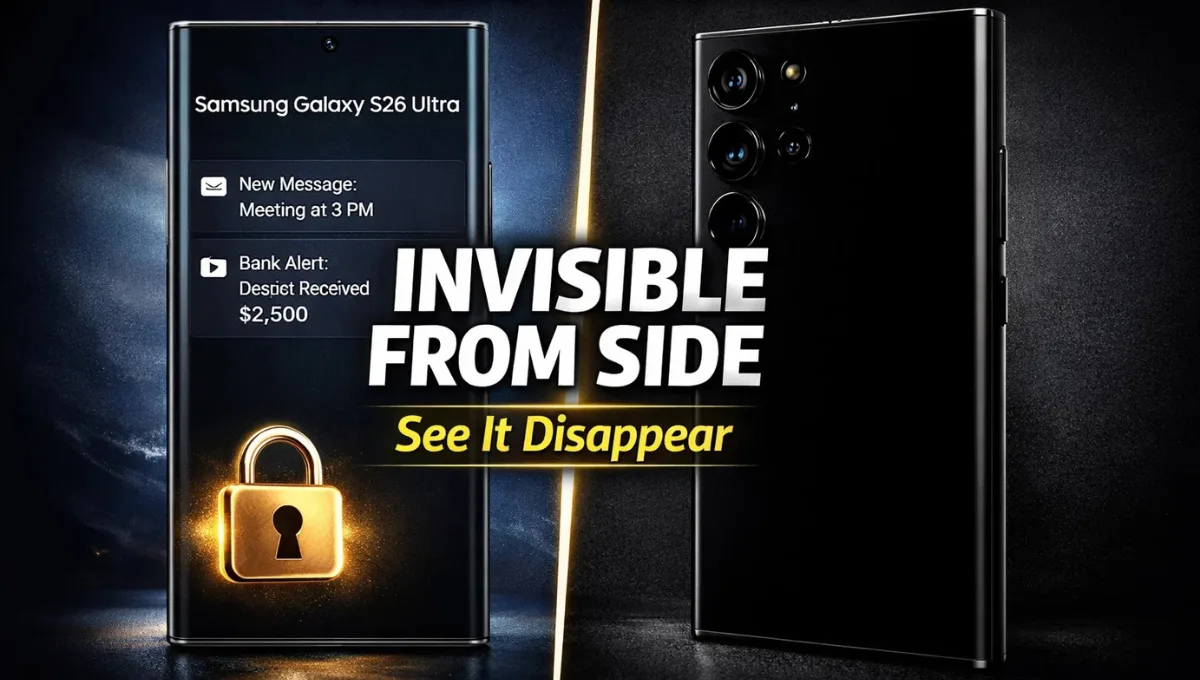
Samsung Galaxy S26 Privacy Display: After more than five years of engineering, Samsung has finally broken its silence about something that feels like a solution to a problem nobody thought could be solved: a display that stays perfectly clear and bright when you look at it straight on, but appears completely dark to anyone peeking from the side. The Galaxy S26 series, arriving in February 2026, will introduce this groundbreaking Privacy Display technology, and it represents a fundamental rethinking of smartphone privacy.
This is not a software trick. It is not a screen protector. It is hardware-level privacy built directly into the display itself – and for commuters, business travelers, and anyone handling sensitive information in public spaces, it changes everything about how secure your phone feels.
The Problem That Took Five Years to Solve
Privacy screen protectors have existed for years. You have probably seen them – those plastic films that reduce your display brightness and introduce a grainy appearance while theoretically preventing shoulder surfers from seeing your screen. They work, sort of. But they come with significant trade-offs: reduced viewing angles, diminished brightness, worse color accuracy, and the constant annoyance of managing a physical film that peels off or collects dust.
Samsung’s approach was different. Rather than layering solutions, the company asked: what if we integrated privacy at the display hardware level itself? The answer came through Flex Magic Pixel technology – a revolutionary approach to controlling light emission at the individual pixel level.
Samsung’s new exclusive feature called Privacy Display uses Flex Magic Pixel technology to ensure that both text and images are invisible when viewed from the side, and the further away someone stands, the less they will see.
How Flex Magic Pixel Technology Actually Works
The display engineering is deceptively simple in concept but extraordinarily complex in execution. Traditional OLED displays emit light equally in all directions from each pixel. The M14 display panel used in the Galaxy S26 Ultra adds a new layer of control: directional pixel emission.
The Samsung Galaxy S26 Ultra uses “Flex Magic Pixel” technology, which is a hardware innovation that reportedly took five years, enabling users to block specific screen areas from being viewed while maintaining access to other parts of the display.
Think of it this way: each pixel becomes directional. When Privacy Display is activated for a specific area on screen, those pixels are instructed to emit light only toward the front of the phone – directly toward your eyes – rather than radiating outward in all directions. To someone viewing the screen from a 30-degree angle, that area appears dark or completely black. To you, looking straight ahead, the display remains perfectly bright and colorful.
The Technical Stack:
This directional control works through a partnership of hardware and software. The hardware provides the pixel-level capability, while One UI 8.5 (Samsung’s upcoming Android interface) handles the intelligence layer. Samsung’s AI recognizes sensitive content – passwords, PIN entries, private messages, banking details – and automatically applies privacy protection to those specific areas.
Even more impressive: the system supports partial, localized privacy control. You are not locked into an all-or-nothing approach where the entire screen dims. Instead, Privacy Display can protect just a notification pop-up while leaving the rest of the screen completely normal. A payment confirmation? Protected. A calendar event? Visible to everyone. This granular control makes the feature practical rather than cumbersome.
Complete Galaxy S26 Series Specifications
Samsung is releasing three models in the Galaxy S26 lineup, each with thoughtfully differentiated specifications matching different user needs.
Galaxy S26 Ultra Specifications (Premium Flagship):
| Component | Specification |
|---|---|
| Display | 6.89-inch M14 AMOLED, 10-bit color depth, 2880x1440px, 120Hz adaptive |
| Privacy Display | Flex Magic Pixel with hardware-level side-view blocking |
| Brightness | Peak brightness: 3,500+ nits (estimated) |
| Gorilla Glass | New generation high-strength with anti-reflective coating |
| Processor | Snapdragon 8 Elite Gen 5 for Galaxy (US/Global) OR Exynos 2600 2nm (Asia/Korea) |
| RAM | 12GB standard, 16GB available in select markets |
| Storage | 256GB, 512GB, 1TB options |
| Battery | 5,000mAh or larger (stacked-cell technology rumored) |
| Charging | 60W wired, Qi2.2 wireless (25W+) |
| Rear Cameras | 200MP f/1.4 main (improved from f/1.7), 50MP f/2.0 ultra-wide, 50MP 3x periscope f/2.9, 12MP telephoto |
| Front Camera | 12MP with under-display technology |
| Dimensions | Approximately 162.8 x 72mm x 8.5mm (estimated) |
| Weight | ~218g (estimated) |
| Rating | IP68 water and dust resistance |
| Colors | Titanium Gray, Titanium Black, Titanium Gold, Titanium Blue, plus regional variants (Pink Gold, Sky Blue rumored) |
| Software | Android 16-based One UI 8.5 with Perplexity AI integration |
Galaxy S26+ Specifications (Mid-Range Flagship):
| Component | Specification |
|---|---|
| Display | 6.7-inch M14 AMOLED (flat), 120Hz adaptive, HDR10+ |
| Privacy Display | Not included (hardware exclusive to Ultra) |
| Processor | Snapdragon 8 Elite Gen 5 or Exynos 2600 |
| RAM | 12GB standard |
| Storage | 256GB, 512GB options |
| Battery | 4,900mAh |
| Charging | 25W wired, Qi2 wireless |
| Rear Cameras | 50MP primary with OIS, 12MP ultra-wide, 12MP 3x telephoto with OIS |
| Software | Android 16-based One UI 8.5 |
Galaxy S26 (Standard):
| Component | Specification |
|---|---|
| Display | 6.3-inch flat LTPO M14 AMOLED, 120Hz adaptive |
| Privacy Display | Not included |
| Processor | Snapdragon 8 Elite Gen 5 or Exynos 2600 |
| RAM | 8GB or 12GB options |
| Storage | 128GB, 256GB, 512GB |
| Battery | 4,700mAh |
| Charging | 25W wired, standard wireless |
| Rear Cameras | 50MP primary with OIS, 12MP ultra-wide, 12MP 3x telephoto with OIS |
| Software | Android 16-based One UI 8.5 |
The Ultra Display Advantage: Why Privacy Display Stays Exclusive
Samsung’s decision to restrict Privacy Display to the Ultra model is practical rather than arbitrary. The feature requires specific hardware integration at the OLED panel manufacturing level. The directional pixel emission capability demands precise manufacturing tolerances, specialized film layers, and advanced testing procedures that currently exist only in Samsung’s premium M14 OLED production lines.
Additionally, the M14 panel itself represents a generational leap. The Galaxy S26 Ultra is said to get a 10-bit display panel, fixing long-standing banding issues, with launch expected in early 2026. Moving from 8-bit to 10-bit color depth enables the display to render more than one billion colors instead of 16.7 million, resulting in smoother color gradients, particularly noticeable in dark scenes and HDR content.
The new high-strength Gorilla Glass adds another layer of differentiation. This generation of Corning glass reportedly offers improved scratch resistance and drop protection, potentially eliminating the need for tempered glass screen protectors altogether. Combined with Privacy Display and 10-bit color, the Galaxy S26 Ultra display becomes genuinely future-facing.
Real-World Use Cases: Where Privacy Display Changes Everything
The practical applications of Privacy Display extend far beyond theoretical scenarios. Leakers and early testers have demonstrated how the feature functions in everyday situations.
On Public Transportation: The most obvious use case. You are checking your bank balance on a crowded train. With Privacy Display activated, a passenger standing next to you sees only a dark rectangle where your notification appears, while you see the balance perfectly. No anxious moments about someone seeing your financial information.
In Professional Settings: You are reviewing confidential documents in a coffee shop while waiting for a meeting. Privacy Display protects the sensitive areas while keeping the rest of your interface visible. Colleagues or competitors cannot casually glance over and read proprietary information.
Password Entry: When entering PINs or passwords, One UI automatically triggers Privacy Display on the input field. The characters remain invisible to anyone viewing from an angle, solving a genuine security vulnerability that has existed since the first touchscreen devices.
Personal Messages: The device enables users to block specific screen areas from being viewed while maintaining access to other parts of the display, which is particularly advantageous for users who frequently work in public spaces or handle confidential information.
Notification Privacy: When a WhatsApp message arrives showing a preview of intimate or sensitive content, the notification area automatically darkens to anyone viewing from the side while remaining fully readable to you.
The Display Privacy Evolution: From Screen Protectors to Built-In Technology
This moment represents a genuine inflection point in smartphone design. For years, privacy has been managed through external solutions – screen protectors, specially designed films, privacy screen apps. All of these come with compromises.
Samsung’s new solution is different. It is built directly into the display panel itself at the “pixel level.” After five years of development, Samsung has created a screen that can stay perfectly clear when you look at it head-on but appears dark or unreadable to anyone looking from a side angle.
The implications are significant. First, this eliminates an entire category of consumer products – physical privacy screen protectors become unnecessary. Second, it sets a new standard for competitor response. Apple and other manufacturers will face pressure to develop equivalent solutions. Third, it demonstrates that meaningful hardware innovation still exists in mature product categories.
Launch Timeline and Availability
Samsung is expected to officially announce the Galaxy S26 series on February 25, 2026, at a Galaxy Unpacked event likely held in San Francisco.
Retail availability is expected to begin in early March 2026, likely March 11 based on typical Samsung launch windows.
Pricing Expectations:
While Samsung has not confirmed pricing, analysts expect the Galaxy S26 Ultra to maintain price parity with the Galaxy S25 Ultra (starting around $1,299 USD), though some reports suggest a potential increase due to manufacturing costs associated with Privacy Display technology.
Regional variations are anticipated – pricing will differ across US, Europe, Asia-Pacific, and other markets based on local factors and import duties.
Key Display Innovations Summary
The M14 OLED Panel:
This is not simply a brightness bump or minor refresh. The M14 represents Samsung’s most advanced OLED implementation:
- 10-bit color depth (versus 8-bit on predecessors)
- Directional pixel emission architecture (Privacy Display)
- Estimated 3,500+ nits peak brightness
- Improved efficiency and reduced power consumption
- Enhanced color accuracy and HDR rendering
Privacy Display Specifications:
- Hardware-level implementation via Flex Magic Pixel technology
- Pixel-level control with One UI 8.5 software integration
- Automatic activation for sensitive content (passwords, PINs, banking apps)
- Manual toggle with customizable settings per application
- Localized/partial privacy control (specific screen areas only)
- Zero brightness reduction when privacy is active
- Zero color distortion unlike traditional privacy films
Beyond Privacy: The Broader S26 Display Story
Privacy Display is Samsung’s primary display messaging, but the upgrade story extends beyond this single feature.
The new Gorilla Glass generation promises improved durability. Anti-reflective coating reduces glare in bright sunlight. Non-polarized light technology improves visibility with sunglasses. The combination of these technologies means the Galaxy S26 Ultra display could represent Samsung’s most comprehensive display overhaul since the introduction of Dynamic AMOLED three generations ago.
Final Assessment
The Samsung Galaxy S26 Privacy Display represents something rare in 2026 smartphone innovation: a genuinely useful feature that solves a real problem. Unlike many flagged innovations that sound impressive in marketing but feel awkward in daily use, Privacy Display integrates seamlessly into normal smartphone behavior.
The technology is mature enough to ship confidently. It is exclusive enough to justify the Ultra model premium. It is useful enough that users will regularly benefit from it. And it is innovative enough that competitors will need to respond.
For anyone spending significant time handling sensitive information in public spaces – and increasingly, that describes most smartphone users – the Galaxy S26 Ultra privacy capabilities represent a meaningful upgrade worthy of consideration.
The question is no longer whether display privacy is possible. Samsung has answered that question definitively. The question now is how quickly this technology cascades through the rest of the mobile industry and becomes table stakes for flagship devices.
Key Takeaways About Galaxy S26 Privacy Display
- Technology: Hardware-level privacy via Flex Magic Pixel technology
- Exclusive To: Galaxy S26 Ultra only (hardware requirements)
- Key Feature: Complete darkness from side angles, full brightness from front
- Customization: Can be enabled/disabled per app, for specific screen areas only
- Additional Upgrades: 10-bit color depth, new Gorilla Glass, improved brightness
- Announcement: February 25, 2026
- Launch: Early March 2026
- Primary Benefit: Eliminates need for physical privacy screen protectors
- Real-World Impact: Transforms how secure users feel handling sensitive information in public
The Privacy Display is not just Samsung showing off engineering prowess. It is Samsung answering a question that has bothered security-conscious users since touchscreen phones arrived: how can we handle sensitive information in public without constant anxiety about who might be watching?
For the first time, smartphones have a hardware-backed answer. And that answer is coming in February 2026.