
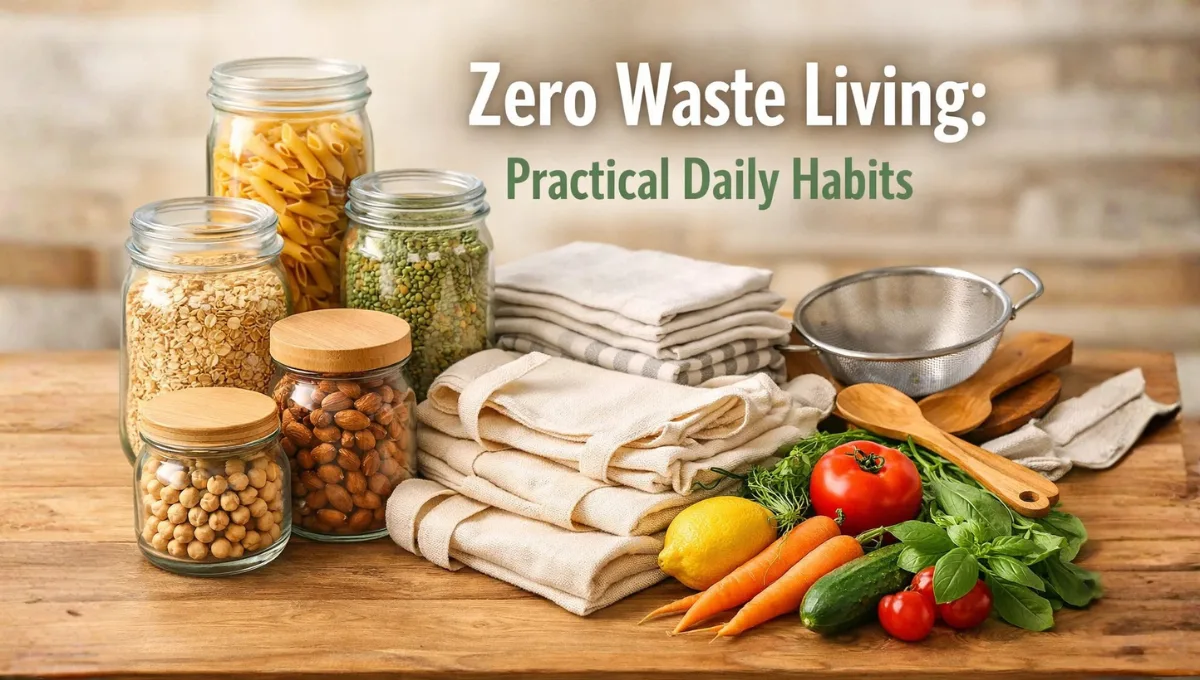
Zero Waste Lifestyle: Picture this: You’re standing in your kitchen at 9 AM on a Tuesday, about to toss that empty shampoo bottle in the trash. But then you pause. Where exactly does it go? A landfill? The ocean? How long will it take to decompose?
This moment of pause is where Zero Waste Lifestyle begins. Not with guilt or judgment, but with genuine curiosity about where our stuff goes and whether there’s a better way.
The good news? There absolutely is. And thousands of Americans are discovering that living with less waste isn’t restrictive it’s actually liberating. In 2026, zero waste is no longer a fringe concept. It’s becoming mainstream because it works. Real families, busy professionals, and thoughtful households are reducing their annual trash to a single grocery bag. And they’re saving money while doing it.
This guide answers the questions you’re probably asking right now: How do I actually start? What’s realistic for my situation? Where do I buy sustainable alternatives? How much will this cost? What if I don’t have access to specialty stores?
Let’s dig in.
Why This Matters?
The Numbers Behind Your Trash
Before diving into how, let’s clarify the why. Americans generate approximately 4.5 pounds of waste per person daily. If you have a family of four, that’s roughly 6,570 pounds per year just from your household.
| Impact | Number | Reality |
|---|---|---|
| Annual US waste per person | 81 lbs per person | Enough to fill a dump truck |
| Landfill decomposition (plastic) | 400-1,000 years | Your single-use items outlive your great-grandchildren |
| Textile waste to landfill yearly | 85 billion lbs | Enough to cover Manhattan 5 layers deep |
| Global plastic in oceans | 8 million metric tons | Equivalent to 55,000 blue whales |
Why Zero Waste Actually Works
Unlike recycling alone (which requires energy and infrastructure), zero waste prevention stops waste at the source. It’s the most efficient environmental choice available. You’re not just moving trash around you’re refusing to participate in unnecessary consumption.
For your wallet: The average American household throws away $1,500 worth of food annually. Add packaging waste, unused items, and impulse purchases, and you’re looking at thousands of dollars per year.
For your time: Less shopping. Less clutter management. More space and mental clarity.
For your health: Fewer synthetic chemicals in your home environment. Potentially cleaner air and water quality in your community.
The Zero Waste Hierarchy
Think of this as a priority checklist. Start at the top and work down.
1. REFUSE
2. REDUCE
3. REUSE
4. RECYCLE
5. ROT (COMPOST)
6. RESIDUAL DISPOSAL
Level 1: Refuse Say no to things you don’t need. This includes promotional items, single-use plastics offered at checkout, and products with excessive packaging. It’s the most powerful action.
Level 2: Reduce Buy less overall. Choose durability over trends. Borrow instead of buy. This cuts waste at the source faster than anything else.
Level 3: Reuse Give items multiple lives. Glass jars, cloth bags, durable containers that circulate through your home for years.
Level 4: Recycle Important, but less impactful than the steps above. Only recycle materials your local facility actually accepts (check their website you might be contaminating the entire batch).
Level 5: Compost Divert organic matter from landfills. This turns kitchen scraps into soil instead of methane.
Level 6: Disposal Unavoidable in modern life, but should be minimal.
Most people focus only on recycling. That’s why we still have a crisis. The real power is in levels 1-3.
Also read:- Smart Lifestyle Trends Reshaping Luxury Island Living in 2026
The Kitchen: Your Zero Waste Command Center
Your kitchen generates the most household waste. It’s also where changes are most visible and motivating. Here’s exactly what to do.
What to Stop Buying Immediately
| Single-Use Item | Reusable Alternative | Cost | Lifespan |
|---|---|---|---|
| Plastic wrap | Beeswax cloth wraps | $12-20 per set | 1+ years |
| Paper towels | Cloth napkins & towels | $15-30 | 5+ years |
| Plastic bags | Canvas/cloth bags | $5-15 per bag | 10+ years |
| Bottled water | Glass bottle + filter | $25-40 | Indefinite |
| Paper napkins | Cloth napkins | $2-5 each | Decades |
| Plastic containers | Glass containers | $10-30 per set | Indefinite |
| Plastic bottles | Glass bottles | $5-15 each | Indefinite |
Quick Math: One family using paper towels spends roughly $100-150 annually. A set of quality cloth towels costs $20-30 and lasts 5+ years. You break even in 2 months.
Where to Actually Buy Zero Waste Kitchen Staples
Online Retailers:
- Package Free Shop (packagefreeshop.com): Wide range of plastic-free kitchen items
- The Good Fill (thegoodfill.com): Refillable home and personal care products with mail delivery
- Who Gives a Crap (au.whogivesacrap.org): Sustainable paper products
- Unpackaged (unpackaged.com): Bulk groceries and eco-friendly alternatives
Local Options:
- Farmers markets (minimal packaging, seasonal produce, local economy)
- Co-ops and independent grocery stores (usually have bulk sections)
- Community Supported Agriculture (CSA) programs (seasonal boxes from local farms)
- Thrift stores and Buy Nothing groups (secondhand items)
Find What Exists Near You:
- Bulk Locator (buylocallyco.com/bulk-locations): Find bulk stores and refill stations by ZIP code
- Farmers Market Search (ams.usda.gov/farmersmarkets): Official USDA directory by location
- Nextdoor App: Ask neighbors where they shop for sustainable goods
Smart Shopping Strategy
Before Every Trip:
- Make a meal plan for the week
- Check what you already have
- Write a detailed list
- Bring containers for bulk purchases
What This Prevents:
- Overbuying fresh items that spoil
- Impulse purchases of unnecessary items
- Multiple shopping trips (saves time and gas)
Real Example: One family I spoke with reduced their food waste by 60% simply by planning meals before shopping. That alone cut their trash by one-third.
Food Preservation 101
Running out of ideas with fresh produce? Learn these basics:
| Method | What Works | Time Investment | Storage |
|---|---|---|---|
| Freezing | Berries, herbs, broth, vegetables | 5-10 minutes | 3-6 months |
| Fermenting | Cabbage, carrots, hot sauce | 15 minutes prep | 6+ months (shelf stable) |
| Pickling | Cucumbers, onions, peppers | 20 minutes | 2-3 months (refrigerated) |
| Dehydrating | Herbs, fruits, tomatoes | Variable | 6-12 months |
Free Resources:
- NCHFP (nchfp.uga.edu): National Center for Home Food Preservation. Trusted, safe guidelines
- Serious Eats (seriouseats.com): Food preservation techniques with photos
Also read:- Noria Robson Luxury Apartments Offer a Fresh Take on Modern Living
Your Bathroom: The Hidden Plastic Problem
Your bathroom likely contains 8-12 single-use plastic items you replace monthly. These are easy swaps.
Bathroom Items You Can Eliminate Immediately
Shower & Bath:
- Liquid shampoo → Solid shampoo bars (lasts 2-3 bottles’ worth; try Lush, Rocky Mountain Soap Co., or Amazon brand Earthly Body)
- Liquid body wash → Bar soap (cheaper, lasts longer, takes less space)
- Plastic loofah → Natural sea sponge or washcloth (compostable when done)
Oral Care:
- Plastic toothbrush → Bamboo toothbrush (compostable handle, remove nylon bristles first)
- Plastic dental floss → Bamboo or silk floss in compostable containers (Georganics or The Humble Co.)
- Bottled mouthwash → Mouthwash tablets or DIY with water, salt, peppermint oil
Personal Care:
- Disposable razors → Safety razor or straight razor (reusable metal; hundreds of shaves per blade)
- Bottled lotion → Solid lotion bars (concentrated formula, lasts longer)
- Deodorant sticks → Solid deodorant paste in glass jars or cardboard
Period Products:
- Disposable pads/tampons → Menstrual cup (Saalt, Cora, Lena; reusable for years; one-time $25-35 cost)
- Or reusable cloth pads (brands: LOLA, Thinx; washable like underwear)
Hair & Nails:
- Cotton balls → Reusable makeup remover pads (Marley Lilly, Etsy)
- Q-tips → Reusable bamboo ear cleaners or The Last Cotton Swab
Where to Buy These Items
Specialist Retailers:
- EarthHero (earthhero.com): Curated plastic-free personal care
- Package Free Shop (packagefreeshop.com): Bath and body section
- Life Without Plastic (lifewithoutplastic.com): Personal care and home goods
- Zero Waste Collective (zerowastecollective.com): Monthly sustainable lifestyle boxes
Mainstream Options:
- Amazon (search “bamboo toothbrush” or “menstrual cup”)
- Target (expanding zero waste section)
- Whole Foods (bulk personal care section)
- Local health food stores
Bathroom Math
| Item | Traditional Annual Cost | Sustainable Alternative | Annual Savings |
|---|---|---|---|
| Shampoo | $60-120 | $5-8 (one bar lasts 2-3 months) | $40-110 |
| Bar soap | Included in shampoo | $4-8 per bar (2-3 year supply) | $50+ |
| Razors | $30-50 | $30 (razor) + $5/year (blades) | $10-15 |
| Menstrual products | $100-150/year | $30 one-time (cup lasts 10 years) | $100-150 |
| Total Annual Savings | — | — | $200-375 |
Clothing & Textiles: The $1,500 Problem
Fashion is the second largest environmental polluter globally. But you don’t need to stop wearing clothes just shift how you acquire and use them.
The Three-Step Wardrobe Revolution
Step 1: Wear What You Own The average person wears only 20% of their wardrobe regularly. Most waste happens because we buy constantly instead of wearing what we have.
Action: Pull out everything you haven’t worn in a year. Donate, sell, or repurpose it.
Step 2: Choose Quality Over Quantity A well-made $80 shirt worn 100 times = $0.80 per wear. A cheap $20 shirt worn 5 times = $4.00 per wear.
Buy fewer, better pieces designed to last 5+ years.
Step 3: Shop Secondhand Buying used gives items a second life and is dramatically cheaper.
Where to Buy Secondhand Clothing
| Platform | Best For | Price Range | Quality |
|---|---|---|---|
| Thrift stores (Goodwill, Salvation Army) | Casual finds, bulk shopping | $2-8 per item | Variable |
| Facebook Marketplace | Local pickup, fast transactions | $3-20 | Variable |
| Depop | Trendy items, younger audience | $5-50 | Variable |
| Poshmark | Designer and brand-name items | $10-100+ | Consistent |
| Vestiaire Collective | Luxury secondhand | $30-500+ | High |
| ThredUP | Casual brands, free shipping | $5-40 | Reliable |
| Grailed | Men’s fashion, streetwear | $10-200+ | Good |
| Local consignment shops | Curated local finds | $5-30 | High |
Pro Tips:
- Search by brand name or item type (not condition)
- Buy off-season (winter coats in spring = 50% cheaper)
- Join “Buy Nothing” Facebook groups in your neighborhood (free items)
- Check local consignment shops before tourist season for best selection
Laundry That Extends Clothing Life
| Practice | Impact | Why It Matters |
|---|---|---|
| Wash in cold water | Extends garment life by 50% | Heat breaks down fibers |
| Wash less frequently | Extends life, saves water/energy | Most items don’t need washing after one wear |
| Air-dry instead of machine dry | Extends life by 50-75% | Dryer heat degrades fabric fastest |
| Use gentle detergent | Reduces fiber breakdown | Harsh chemicals damage material |
| Mend small holes immediately | Extends wearable life by 1-2 years | Small tears become big holes fast |
| Store properly (fold, not hang) | Prevents stretching | Heavy knits get damaged on hangers |
Free Mending Resources:
- YouTube channels: Search “how to hand sew” or “darning tutorial”
- r/Visiblemending (Reddit): Community showing beautiful repair techniques
- Local sewing circles: Ask at community centers or fabric stores
Textile Disposal
When clothing reaches the end, don’t throw it away:
- Donation: Goodwill, Salvation Army, religious organizations, shelters
- Textile recycling: Earth911.com/recycling (search “textiles”)
- Creative reuse: Cut into rags, stuff for pet beds, use as cleaning cloths
- Textile-to-fiber programs: Some companies (like Patagonia) recycle old garments into new materials
Household Cleaning: The Chemical Closet Problem
Most people keep 15-20 cleaning products under their sink. You need maybe three.
The Basic Zero Waste Cleaning Kit
| Product | Uses | Cost | Where to Buy |
|---|---|---|---|
| Baking soda | Scrubbing, deodorizing, drain cleaning | $0.50/lb | Any grocery store (bulk section) |
| White vinegar | Disinfecting, degreasing, deodorizing | $0.50/gallon | Any grocery store |
| Castile soap (Dr. Bronner’s) | Everything dilute to preference | $4-6 per bottle | Whole Foods, Trader Joe’s, online |
| Essential oils (optional) | Scent, antimicrobial boost | $5-15 per bottle | Local health store, online |
| Microfiber cloths | Cleaning surfaces | $0.50-2 each | Dollar store, bulk retailers |
Total investment: $10-20. Lasts 6-12 months.
DIY Cleaning Recipes (No Measuring Required)
All-Purpose Surface Cleaner:
- 1 part white vinegar + 1 part water + few drops essential oil (optional)
- Works on: counters, tables, mirrors, floors
Bathroom Scrub:
- Baking soda + water until paste-like
- Add few drops essential oil for scent
- Works on: tubs, showers, tile, scrubbing tough stains
Drain Cleaner:
- 1/2 cup baking soda + 1 cup white vinegar (it’ll fizz this is normal)
- Wait 30 minutes, flush with hot water
- Works on: slow/clogged drains
Toilet Bowl Cleaner:
- 1 cup white vinegar + 2 tablespoons baking soda + essential oil
- Let sit 30 minutes, scrub, flush
- Works on: stains and disinfecting
Laundry Detergent (optional, for the committed):
- 1 cup baking soda + 1 cup washing soda + 20-30 drops essential oil
- Use 2 tablespoons per load
- Makes: enough for 50+ loads for ~$3
Free Guidance:
- Dr. Bronner’s website (drbronner.com): Detailed dilution charts for their soap
- The Spruce (thespruce.com): Search “DIY cleaning recipes”
Waste-Free Cleaning Tools
| Tool | Replaces | Cost | Lifespan |
|---|---|---|---|
| Microfiber cloths | Paper towels | $0.50-2 each | 2+ years |
| Cloth napkins | Paper napkins | $2-5 each | Decades |
| Natural bristle brushes | Plastic-handled brushes | $3-8 | 5+ years |
| Bamboo scrubbers | Plastic scrubbers | $2-4 | 1-2 years |
| Wooden clothesline | Dryer | $10-20 | 10+ years |
Food Waste & Composting: The Hidden Gold Mine
Organic matter comprises 30% of landfill waste. In landfills, it releases methane (a potent greenhouse gas). Composted, it becomes nutrient-rich soil.
Composting Options by Living Situation
Apartment (No Yard)
| System | Space | Cost | Smell | Odor Control |
|---|---|---|---|---|
| Countertop bokashi | 1 sq ft | $30-60 | Minimal | Fermented/neutral |
| Worm bin (vermicomposting) | 2-3 sq ft | $30-100 | None | Bedding absorbs |
| Electric composter | 1.5 sq ft | $300-500 | None | Heats/dries waste |
| Small outdoor bin (balcony) | 1 sq ft | $20-50 | Minimal | Proper layering |
Recommended For Apartments: Bokashi or worm bin (cheapest, quietest, no smell)
House with Yard
| System | Space | Cost | Time-to-Compost |
|---|---|---|---|
| Open pile | 3×3 ft minimum | $0 | 6-12 months |
| Bin system | 2×2 ft | $40-150 | 3-6 months |
| Tumbler | 2×2 ft | $100-200 | 4-8 weeks |
Recommended For Homes: Bin system or tumbler (faster than pile, contained, rodent-proof)
No Yard / No Space?
- Municipal composting: Many cities offer curbside pickup (like garbage day). Search “[your city] composting program”
- Community gardens: Host compost piles accepting residential material
- Local farms: Call nearby farms many accept food scraps
- Find drop-off sites: SEARCH EarthU911.com/recycling (type “compost”), Compost Directory (compostdirectory.org)
What You Can Compost
YES, Compost:
- Fruit and vegetable scraps
- Eggshells (crushed)
- Coffee grounds and tea bags
- Cardboard and paper (shredded)
- Leaves and grass clippings
- Straw and hay
- Wood chips (untreated)
- Sawdust (untreated)
NO, Don’t Compost:
- Meat, fish, or bones
- Dairy
- Oils or fats
- Pet waste
- Diseased plants
- Treated wood or paper
- Glossy/coated cardboard
Composting Resources
- Master Gardener Program (Search “Master Gardener” + your county): Free local expertise
- Compost Guide (compostingguide.com): Visual guides for beginners
- Local Compost Facility Finder (search “compost near me” + your ZIP code)
Real Costs: What Zero Waste Actually Expenses
Year 1 Startup Costs (Complete Household)
| Category | Items | Estimated Cost |
|---|---|---|
| Kitchen | Containers, cloth wraps, reusable bags, composting bin | $100-200 |
| Bathroom | Toothbrush, soap, menstrual cup, razor | $50-100 |
| Cleaning | Supplies and brushes | $20-30 |
| Clothing | Secondhand wardrobe building | $0-100 (optional) |
| Shopping tools | Cloth bags, glass containers for bulk | $30-50 |
| Total | $200-480 |
Year 1 Savings
| Category | Monthly Savings | Annual |
|---|---|---|
| Reduced grocery waste | $50-100 | $600-1,200 |
| Secondhand shopping | $30-60 | $360-720 |
| Reduced packaged goods | $20-40 | $240-480 |
| Bathroom products | $15-30 | $180-360 |
| Cleaning supplies | $10-15 | $120-180 |
| Fewer shopping trips | $20-40 | $240-480 |
| Total | $145-285 | $1,740-3,420 |
Break-Even Timeline: 2-4 months, then pure savings.
Common Problems & Real Solutions
“I live nowhere near bulk stores or farmers markets.”
Your options:
- Order bulk staples online: Vitacost.com, Thrive Market (thrivemarket.com), Azure Standard (azurestandard.com)
- Join a buying club with neighbors (split shipping)
- Ask local grocery stores to stock bulk items (they respond to customer requests)
- Start your own Buy Nothing group on Facebook for your neighborhood
- Shop what’s available secondhand (less shipping than buying new)
“My family thinks I’m being extreme.”
Start small, show results:
- Don’t announce changes; just stop buying disposables
- Keep reusables visible and convenient (family uses them naturally)
- Track savings and share the numbers
- Focus on benefits they notice: cleaner home, better food quality, lower bills
- Let habit change their mind, not arguments
“I’m on a tight budget isn’t zero waste expensive?”
Actually, no:
- Secondhand shopping = spending 50-75% less
- Bulk buying = lower per-unit cost
- Fewer impulse purchases = more money saved
- The upfront investment pays back in 2-4 months
Start with one category (kitchen OR bathroom). Don’t invest in everything at once.
“It’s impossible because of my job/family situation.”
Meet yourself where you are:
- Reduce before reusing (you don’t need perfect systems)
- Pick one habit, master it, add another
- Focus on what’s easy in your situation (secondhand shopping, meal planning, composting)
- Progress > perfection
“My city doesn’t offer municipal composting.”
Direct solutions:
- Start your own bokashi or worm bin
- Join a community garden composting program
- Partner with a local farm
- Advocate for municipal composting (write city council, join environmental groups)
Temporary solution: Keep compostables in a freezer until you find a drop-off location.
Beyond Your Home: Extending Zero Waste Thinking
Once you’ve optimized your household, these small shifts multiply your impact:
At Work
- Bring lunch in reusable containers
- Keep a reusable water bottle at your desk
- Use digital documents (print only when necessary)
- Suggest your company reduce packaging in supplier orders
- Start or join a Buy Nothing group at work
While Shopping
- Bring your own containers, bags, bottles
- Support businesses using minimal packaging
- Write reviews mentioning sustainable practices (companies respond to feedback)
- Ask questions: “Do you have plastic-free options?”
While Traveling
- Pack reusables (water bottle, food container, cloth napkin, soap bar)
- Choose accommodations with sustainability practices (check their website)
- Support local restaurants over chains
- Use public transportation
In Your Community
- Join local environmental groups
- Attend city council meetings advocating for composting/recycling
- Support farmers markets and local businesses
- Teach others (kids, friends, family) through example
Measuring Your Progress
Unlike abstract environmental goals, zero waste progress is visible and measurable.
Month 1-3: Awareness Phase
- Notice baseline waste (how full is your trash can weekly?)
- Make initial swaps (reusable bags, cloth napkins, bulk shopping start)
- Expected change: 20-30% reduction
Month 3-6: System Building
- All major reusables in place
- Shopping habits changed
- Composting started
- Expected change: 50-60% reduction
Month 6-12: New Normal
- Zero waste is now habit, not effort
- Annual trash volume drops to 1-3 bags
- Financial savings become obvious
- Expected change: 70-90% reduction
Year 2+: Maintenance
- Most systems automated
- Minimal trash generated
- Community ripple effects (friends/family asking questions)
- Fine-tuning based on what you’ve learned
Track These Numbers
- Garbage bag count per month
- Annual spending on groceries
- Amount of food wasted per week
- Money saved on bathroom/cleaning products
The data will surprise and motivate you.
How Luxury Island Communities Are Pioneering Zero Waste
Interestingly, some of the world’s most exclusive island destinations are leading zero waste innovation. Island resorts and private communities face unique constraints: limited landfill space, expensive trash export, precious freshwater, fragile ecosystems.
These constraints breed solutions.
Image: Sunrise over a sustainable island resort with solar panels and rainwater collection systems credit via luxury travel photography
High-end island resorts now implement:
- Comprehensive composting systems for all organic waste
- Wastewater treatment facilities that regenerate water for landscaping
- Solar and wind power eliminating garbage from diesel generators
- Local sourcing networks that drastically reduce packaging
- Zero waste certifications for residents and ongoing guests
For affluent travelers and potential residents, this signals something important: choosing zero waste isn’t contrary to luxury it’s becoming aligned with the most thoughtfully designed destinations.
These island communities have also revealed a key insight: individual zero waste efforts work best within systems that support them. Your home composting helps, but municipal composting infrastructure helps more. Your reusable shopping bags help, but bulk-buying systems help more.
This is why zero waste adoption accelerates in neighborhoods and cities where people advocate for systemic change together.
Frequently Asked Questions
1. Is zero waste actually possible?
2. What about recycling? Isn’t that enough?
3. Can I do zero waste on a limited budget?
4. What’s the single most impactful change I can make?
5. How do I handle resistance from family members?
6. What if I can’t compost (apartment, no space)?
7. Isn’t this just for wealthy people?
Your Zero Waste Starting Checklist
Not sure where to begin? Pick one category and master it before moving to the next.
Week 1-2: Assessment
- Track your waste for one week (how many bags? what’s inside?)
- Calculate current spending on groceries, toiletries, cleaning supplies
- Identify your nearest farmers market, co-op, or bulk store
- Check if your city offers municipal composting
Week 3-4: Kitchen Changes
- Get reusable shopping bags, cloth wraps, glass containers
- Make your first farmers market or bulk store trip
- Start composting (even if just keeping scraps in freezer)
- Choose one packaged item to replace with bulk/secondhand version
Week 5-6: Bathroom Changes
- Replace one personal care item (shampoo bar, bamboo toothbrush, menstrual cup)
- Build a basic cleaning supply kit
- Donate unused bathroom items
Week 7-8: Consolidation
- Establish recurring shopping day/location
- Set up your composting system
- Replace remaining single-use items as they run out
- Measure your waste reduction
Key External Resources for Deeper Dives
Comprehensive Guides & Communities:
- Zero Waste Home (zerowastehome.com): Foundational zero waste resource, started the movement
- Trash is for Tossers (trashisfortossers.com): Visual guides and beginner tips
- r/ZeroWaste (reddit.com/r/zerowaste): Active community answering questions daily
Shopping & Sourcing:
- Bulk Locator (buylocallyco.com/bulk-locations): Find bulk stores by ZIP code
- USDA Farmers Market Directory (ams.usda.gov/farmersmarkets): Find local farms
- Buy Nothing Project (buynothingproject.org): Connect with community neighbors
- Earth911 Recycling Search (earth911.com/recycling): Find composting and specialty recycling
Specific Topics:
- Textile Recycling (earth911.com/recycling + search “textiles”)
- Home Food Preservation (nchfp.uga.edu): National Center for Home Food Preservation
- DIY Cleaning (drbronner.com): Dr. Bronner’s dilution charts
- Secondhand Fashion (Depop, Poshmark, ThredUP, Vestiaire Collective)
City/Regional Programs:
- Search “[Your City] + composting program” or “[Your County] + waste reduction”
- Contact your local waste management facility directly they often have programs you don’t know exist
- Join local Buy Nothing groups on Facebook
Your Next Step
Zero waste living isn’t about perfection. It’s about direction.
Start small. Pick one habit. Make it easy. Notice what changes. Then add another.
You’ll discover something that most zero waste practitioners discover: this way of living isn’t restrictive. It’s actually freeing. You spend less money. Your home feels less cluttered. You know where things come from. You’re participating in a system that makes sense.
In 2026, that alignment between actions and values is becoming increasingly valuable.
What’s your biggest barrier to starting right now? Leave a comment below and let our community help. We’ve likely solved the same problem.
Warmly,
Alison Rosen
Editor-in-Chief, Eden Isle
Bookmark These Pages for Reference
- Bulk Store Finder: buylocallyco.com/bulk-locations
- Farmers Markets: ams.usda.gov/farmersmarkets
- Composting Options: earth911.com/recycling (search “compost”)
- DIY Cleaning: drbronner.com (scroll to “uses” section)
- Zero Waste Community: reddit.com/r/zerowaste
- Secondhand Marketplace: Depop, Poshmark, ThredUP, Facebook Marketplace
- Food Preservation: nchfp.uga.edu
3 thoughts on “Zero Waste Lifestyle: Practical Daily Habits for a Sustainable Lifestyle”